


New to ICU 2.0: A Visual Guide to Critical Care Nursing
New to ICU 2.0: A Visual Guide to Critical Care Nursing
Prepares you before the preceptor tests you
Built for visual learners, not text walls
Real clinical scenarios, no fluff
Works mid-shift when things go sideways
Couldn't load pickup availability

New to ICU 2.0: A Visual Guide to Critical Care Nursing
WARNING: Low Stock Notice
This product sold out 9 times in the last 6 months. The current sale price is not guaranteed past today. Only available here — don't get caught buying counterfeits on Amazon or eBay.
Benefits
Benefits
Your first ICU shift will test you before you feel ready. The difference between a nurse who answers confidently and one who freezes isn't experience — it's preparation.
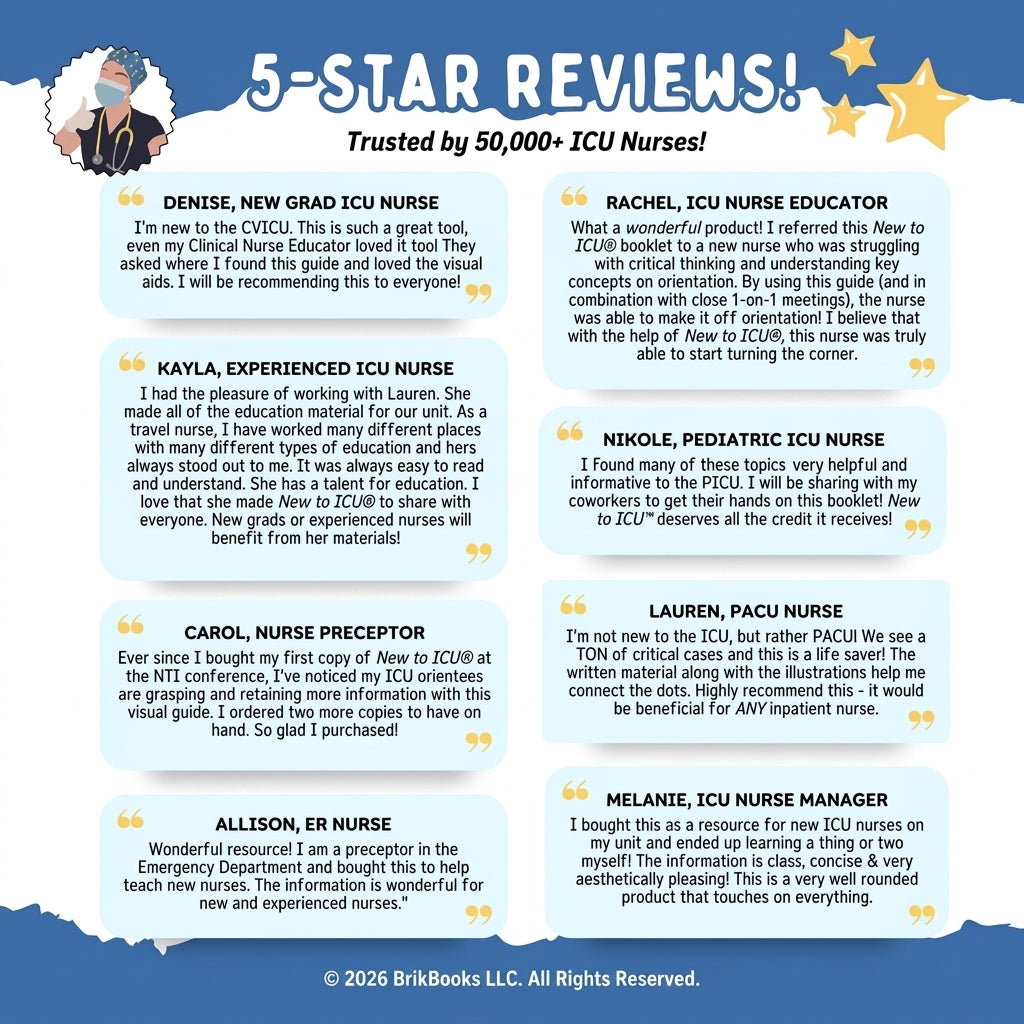
New to ICU replaces the dense binders most hospitals hand you with color-coded diagrams and clinical scenarios pulled straight from real ICU floors. Validated by Clinical Nurse Specialists. Used by 50,000 nurses, from new grads to 9-year veterans who still open it on complex cases.
Features
Features
120 pages, 10 sections. Physical book. Covers: neuro, cardiac, trauma, respiratory, invasive monitoring, continuous infusions, GI/GU, labs, daily screenings. New in v2.0: Lab Fundamentals, Daily ICU Screenings, Trauma. Validated by Clinical Nurse Specialists and peer review team.
"I'll learn everything on the job."
"I'll learn everything on the job."
You will — but your preceptor is watching from day one. The nurses in this book walked in already knowing MTP ratios, vasopressor titration rules, and bladder pressure setup. That's not luck. That's prep.
"I'm an experienced nurse, I don't need a beginner guide."
"I'm an experienced nurse, I don't need a beginner guide."
9-year ICU veterans use this book to precept. The Cardene drip you've never run, the open abdomen case you get blindsided with at 0300 — it's in here, with a diagram.
Is this for new grads only?
Is this for new grads only?
No. New grads, nurses transitioning into ICU, and experienced nurses who precept all use it. The visual format works as a teaching tool as much as a study tool.
Shipping + Guarantee
Shipping + Guarantee
ALL orders will take 2-4 days for processing and allow for 7-12 days for delivery.
ALL orders covered by our 30 day Guarantee :)
life saver of a book! I got blindsided by a Cardene drip I'd never run, opened this book mid-shift, found it at the top of the page, and titrated the patient off before the end of my shift


What Changes When You Read This
The Gap Between You and the Nurse Who Already Knows What's Coming
The Problem
Your preceptor asks about MTP ratios, vasopressor titration, bladder pressures — and the hospital binder they handed you is 200 pages of dense text nobody reads. That's not a knowledge gap. It's a format problem.
The Window
The first 90 days are when your clinical instincts get built — or don't. New to ICU replaces binders with color-coded diagrams of the exact scenarios that blindside new grads: trauma admissions, vasopressor decisions, post-op CABG hemodynamics.
The Advantage
When a Cardene drip lands on you mid-shift that you've never run — you open the book, find it at the top of the page, and titrate the patient off by end of shift. Your peers figure this out after the moment has passed. You walk in with a preceptor in your pocket.
"I didn't know new grads could come this prepared. Where did you learn all this?"
— ICU Preceptor, after her orientee walked in with New to ICU


Walk In Three Steps Ahead
Your preceptor expects to spend the first week catching you up. New to ICU covers the exact scenarios — MTP, vasopressors, open abdomens — before you ever see them on the floor. You answer before they finish asking.

Built for the Shift That Goes Sideways
The ICU doesn't wait for you to feel ready. When a drip you've never run lands on your assignment mid-shift, you need an answer in 60 seconds — not a textbook chapter. This is the resource you pull out when the plan changes.

Complex Concepts, Finally Visual
Dense walls of text don't work at 3am when a trauma rolls in. Every protocol, every piece of equipment, every drug titration in this guide is mapped out in color-coded diagrams your brain can actually process fast — the way ICU nursing actually happens.

120 Pages. 10 Sections. Nothing You Don't Need.
Neuro, cardiac, trauma, respiratory, invasive monitoring, continuous infusions, GI/GU, labs, daily screenings — every system covered in one physical guide. CNS-validated. Peer-reviewed. Built by a former new grad ICU nurse who knew exactly what orientation was missing.
Side by Side
New to ICU vs. Every Other Resource Your Hospital Handed You
| Typical Hospital Binder | New to ICU | |
|---|---|---|
| How Concepts Are Delivered | Dense walls of text, no visuals | Color-coded diagrams & visual walkthroughs |
| Scenarios Covered | Generic & incomplete | MTP, vasopressors, open abdomen, post-op CABG, drip titration |
| Usable Mid-Shift | Nobody opens it | ✓ |
| Validated by Clinical Nurse Specialists | Unknown source | ✓ |
| Covers Equipment Step-by-Step | Rarely, if ever | A-lines, CVCs, vents, Swan-Ganz, ECMO & more |
| Preceptor Reaction | Spends week 1 catching you up | "Are you sure you're a new grad?" |
| Works for Experienced Nurses Too | Not designed for it | 9-year veterans still open it on complex cases |
| Used by | Your hospital only | 50,000+ nurses |
| Confidence After Reading | Still nervous going in | Walk in three steps ahead |
Verified Buyers
What Nurses Said After Their First Shift With This Book
Jasmine T. — New Grad, MICU
My preceptor threw a vasopressor question at me on day three of orientation. I answered it — correctly, in detail — and she stopped mid-sentence and said "are you sure you're a new grad?" I had read that exact section two nights before my shift. This book made that moment possible.
Darnell R. — RN transitioning from Med-Surg
Six years on a med-surg floor and I still felt completely lost walking into the ICU. The equipment alone — A-lines, Swan-Ganz, arterial waveforms — none of that was in my wheelhouse. I read this cover to cover before my first week. By week two I was setting up pressure lines without asking for help.
Priya M. — ICU Preceptor, 9 years
I buy a copy for every orientee I take on. The ones who come in having read it are visibly different from day one — they ask better questions, they don't freeze during report, and I spend less time on basics and more time on clinical judgment. I've been a nurse for nine years and I still open this book on complex cases.
Keisha W. — New Grad, Surgical ICU
I got a Cardene drip on my third week of orientation — a patient I had never managed that type of infusion on before. I pulled out this book at the nurse's station, found the page in under a minute, read the titration protocol, and handled it. By end of shift the patient was off the drip. That would not have happened without this book in my bag.
Marcus A. — RN, Trauma ICU
The trauma section alone is worth the price. MTP activation, team roles, the Trauma Diamond — all of it laid out visually in a way that actually makes sense before you've ever seen it happen in real life. My first trauma admission, I was ready. My preceptor noticed.
Tanya B. — CCRN, Charge Nurse
I've been precepting for four years and I've never had a resource this good to hand off to new grads. The visual format is the difference — most nursing education is text-heavy and abstract. This is concrete, diagram-based, and built around what actually shows up in the first 90 days. I keep a copy at the charge desk.
Alicia F. — New Grad, Cardiac ICU
Post-op CABG patient, Swan-Ganz in, preceptor asking about preload and afterload. I answered every question. She looked at me like I'd been doing this for years. I had been studying the cardiac hemodynamics section every night for two weeks before that shift. The visual diagrams made those concepts lock in differently than any lecture ever did.
Brendan O. — ER RN transitioning to ICU
I came from the ER where everything moves fast and protocols are second nature. ICU is a completely different world — longer shifts, more complex patients, equipment I'd never touched. This book bridged that gap faster than anything my hospital gave me at orientation. The invasive monitoring section is exceptional.
Simone L. — New Grad, Neuro ICU
The neuro section covers EVDs, ICP monitoring, NIH stroke scale, and craniotomy vs craniectomy differences — all in one place with visuals. I had a patient with an EVD on my second week. I wasn't guessing. I knew the setup, the monitoring parameters, and what to watch for because I had read those pages three times before that shift.
Diana C. — ICU Preceptor, 12 years
When I started in the ICU there was nothing like this. We got a binder and a prayer. The orientees I precept now who have read this book come in with a mental model already built — they're not learning what a central line is while standing next to one. That shift in baseline makes my job significantly easier and their orientation significantly safer.
Natalie H. — New Grad, Medical ICU
Septic shock patient, MAP dropping, preceptor watching. I uptitrated the Levo in small increments, evaluated SVV, and called for Vasopressin as second line — then caught myself before titrating it because I knew it was a fixed dose. My preceptor told me later that was the moment she stopped worrying about me. I had read that section the night before.
Terrell M. — RN, transitioning from PACU
PACU to ICU is a bigger jump than most people expect. The acuity, the equipment, the protocols — it's a different world. This book covered the gaps I didn't even know I had. The continuous infusions section alone saved me from three mistakes in my first month that I can look back on clearly now.
Rochelle S. — New Grad, Cardiovascular ICU
I studied this book like it was a board exam. Balloon pumps, Impella, ECMO — concepts I had never seen outside of a textbook. When a patient came in on an Impella during my fourth week of orientation, I wasn't starting from zero. My preceptor walked me through the specifics, but the foundation was already there.
Angela V. — Clinical Educator, ICU
I ordered 12 copies for our unit's new grad cohort. We incorporated it into orientation as a required reference — not assigned reading, but a bedside tool. The feedback from the cohort was unanimous: the visual format made complex concepts land in a way that hours of lecture hadn't. We'll be reordering every cycle.
Isaiah P. — New Grad, Burn ICU
Burn ICU is its own world but the fundamentals are the same — hemodynamics, vents, drips, invasive monitoring. This book had me fluent in the language before orientation ended. My preceptor told me at the end of month two that I was the most prepared new grad she had taken on in three years. I gave her the book to keep.
Vanessa K. — RN, transitioning from Telemetry
Four years in telemetry and I still felt underprepared walking into the ICU. The gap between tele and critical care is real. This book closed it faster than the three-month transition program my hospital ran. I wish I had found it six months earlier.
Olivia N. — New Grad, MICU
Open abdomen patient, my first week. Preceptor asked if I knew what "discontinuity" meant in report. I explained the bowel ends, the wound vac, the NPO status. She stopped walking and turned around. That question was supposed to stump me. It didn't. Page 101 of this book had walked me through the whole setup two days earlier.
Raymond T. — ICU Preceptor, 7 years
I used to spend the first two weeks of orientation just getting new grads comfortable with the equipment. The ones who came in having read this book skip that entire phase. They walk in knowing what a central line looks like anatomically, how to read a vent, what they're looking for on an A-line waveform. That's two weeks of orientation I get back to spend on judgment and critical thinking.
Monique B. — New Grad, CTICU
The code cart section stopped me cold the first time I saw it. This is exactly how the medications are laid out in the actual cart — same organization, same format. When I opened a real crash cart for the first time I already knew where everything was. That is not a small thing in a code situation.
Latoya G. — RN, transitioning from Step-Down
Step-down to ICU felt like starting over. Different patients, different equipment, different pace of deterioration. I read this book every night for three weeks before my first ICU shift. The lab fundamentals section and the daily screening tools section got used every single day in my first month. Still use them now.
Carlos E. — New Grad, Neuro ICU
Fresh cardiac arrest patient, TTM protocol ordered. I didn't freeze. I knew the parameters, I knew the monitoring, I knew what to watch for during the cooling phase. My preceptor asked how I knew the TTM protocol that well. I showed her the page. She photographed it.
Stacy H. — ICU Preceptor, 5 years
The CNS validation matters. I've seen a lot of unofficial nursing guides floating around — some of them have errors that would get a new grad into trouble. This one has been reviewed and validated. I trust handing it to my orientees because I know the clinical information is accurate.
Destiny W. — New Grad, MICU
I read this on my commute, during lunch, before bed. Every spare moment in the two weeks before my orientation started. By the time I walked onto that floor I had already mentally rehearsed the scenarios. The real situations still challenged me — but they didn't shock me. That gap is everything in a critical care environment.
Jerome F. — RN, transitioning from PCU
The respiratory section is comprehensive in a way I didn't expect — vent settings, PEEP, SBTs, extubation criteria, intubation. All of it in one section with visuals. I had been terrified of vented patients my entire PCU career. After reading that section twice, I understood what I was looking at on the vent screen for the first time.
Adrienne C. — New Grad, Surgical ICU
My hospital's orientation binder is 240 pages of dense policy text. Nobody reads it. This book is 120 pages of exactly what you need to know, built around diagrams and scenarios. I read the whole thing in four sittings. The hospital binder is still sitting on my kitchen counter untouched.
Nkechi A. — ICU Preceptor, 8 years
I recommend this to every nurse I know going to the ICU — new grad or experienced. The pocket cards pair with the book in a way that actually works at the bedside. My orientees keep the cards clipped to their badge holder. I've seen it bail people out mid-shift more than once.
Tiffany D. — New Grad, MICU
Shipping took about 10 days which was longer than I expected — I had already started orientation by the time it arrived. That said, I read it cover to cover in my first week and it immediately changed how I approached my shifts. Support responded quickly when I reached out about the delay. The book itself is exactly what it promises.
Marcus L. — New Grad, Cardiac ICU
I was three steps ahead of every question my preceptor asked in the first month. She started bringing the book into patient rooms to use as a teaching tool with me at the bedside. By week six she told me I was the most prepared orientee she had taken on in her career. This book built that.
Sandra P. — RN transitioning to ICU
The cover arrived with a small crease — I had ordered it as a gift for a colleague starting her ICU orientation. Emailed support with a photo and they shipped a replacement within two days, no questions asked. The content itself is excellent and my colleague has been using it daily since orientation started.
Brianna J. — New Grad, Medical ICU
I bought this skeptical that a book could actually prepare me for ICU orientation. Two months in, my preceptor handed me a copy of the same book and said she'd bought it for herself because she kept borrowing mine. There is nothing else at this price point that delivers what this delivers.

The ICU Guide Built for Real Shifts
120 pages. 10 sections. Every system you'll face in your first 90 days — laid out visually so it sticks before you ever stand at that bedside. CNS-validated, zero fluff, built by a nurse who lived orientation.
Got Questions